_edited.png)
Abhyanga: The Ayurvedic Self-Massage That Calms Vata and the Nervous System
- juliewardwell
- Feb 14
- 8 min read

Sneha means both oil and love — a daily practice for deep nervous system support
There is one relationship that rarely gets the tenderness it deserves: the one we have with our own bodies. Ayurveda offers a beautiful way to tend it, and it begins with a single word.
In Sanskrit, the word for oil is Sneha (SNAY-huh). But Sneha does not only mean oil. It also means love, tenderness, and deep affection. The practice of oiling the body, Snehana (snay-HAH-nuh), carries both meanings at once: to oil oneself and to love oneself. Ayurveda sees no real difference between the two. When you warm oil in your hands and draw it slowly across your skin, you are not simply moisturizing. You are practicing love in its most physical, tangible form.
That practice has a name: Abhyanga (ah-bhee-YUN-guh).
What Is Abhyanga?

Abhyanga is a full-body warm-oil self-massage, and one of the most valued practices in the whole of Ayurvedic daily self-care. The word is sometimes translated as "toward the heart," which describes both the direction of the strokes and the intention behind them.
Here is how it works. You warm herb-infused oil and apply it to the entire body with open palms, using long, flowing strokes along the limbs and circular movements around the joints. Each stroke stimulates vital energy points across the body. In Ayurveda, the home of Vata (Air energy) is the nervous system, which is intimately connected to the sense of touch held in the skin. This is why oiling the body has such a profoundly calming effect. Applying warm oil to the skin soothes Vata right at the place where the nervous system meets the outside world.
This is also why Abhyanga is considered Ayurveda's foremost daily practice for settling an overstimulated nervous system. When Vata runs high, light, quick, and mobile, the mind races, sleep turns shallow, and the body struggles to feel grounded. Warm oil is the direct opposite: heavy, steady, warm, and grounding. Practiced regularly, Abhyanga helps manage that restless, overstimulated quality and invites the nervous system back toward steadiness.
Why Abhyanga Feels Like Love
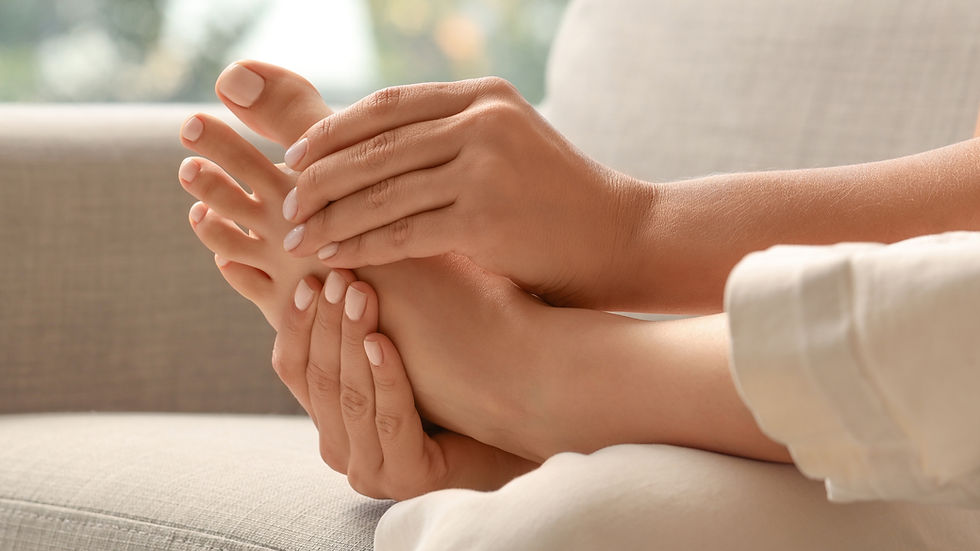
The link between Sneha and love is not only poetic. Modern research helps explain why self-massage creates such a deep sense of warmth and stability.
A well-known UCLA study found that just fifteen minutes of moderate-pressure massage significantly raised oxytocin, the hormone associated with bonding, trust, and the warm feeling we connect with love, while lowering stress hormones in the body. And a 2025 study in Physiology & Behavior found something remarkable: self-touch, not only touch from another person, but also raises oxytocin. Your own hands, moving with warmth and intention across your own skin, can call up the same bonding hormone that flows during an embrace.
This is the quiet science behind Sneha. In Abhyanga, oil and love produce the same response in the body.
What Daily Abhyanga Supports

The foundational Ayurvedic texts describe a wide range of benefits from daily self-Abhyanga, and they are the kind of benefits you feel building gently over time rather than all at once. Understood in the traditional sense, a regular home practice is said to:
Build physical strength and resilience, nourishing the deep tissues so the body feels sturdier and holds up well, even under the demands of a busy life
Nourish and moisturize the skin, easing dryness and improving tone, suppleness, and a healthy glow
Bring a grounded sense of calm, settling restless Vata and helping the nervous system move from overstimulation toward steadiness
Ease fatigue and tension, as the rhythmic strokes release what the body has been holding
Support graceful aging, keeping the tissues nourished and the skin resilient over the years
Encourage sound sleep, easing the nervous system into rest, especially with an evening practice
Support clear vision and mental clarity, particularly when the head and scalp are included
The cornerstone texts put it beautifully: the person who practices oil massage regularly becomes strong, graceful, and less troubled by age, with a body that holds up well even under hard work. What Ayurveda observed over thousands of years that steady, loving touch settles the body and mind is the same steadiness a daily home practice offers now. Consistency matters more than length. A short massage practiced daily builds a cumulative calm that an occasional long session cannot replace.
How Deep Does the Oil Go?
Ayurveda describes Sneha as subtle, able to pass through the body's tiniest channels to reach the deepest tissues.
The texts tell us that oil applied through massage reaches the hair follicles in roughly ninety-five seconds. Over the next few minutes, it travels progressively deeper, into the blood, then muscle, then fat and bone. By about five minutes it reaches the bone marrow and nerve tissue. A self-massage of ten to twenty minutes is enough to receive benefit all the way to these deepest layers.
The Power of Oiling the Navel

Of the many vital energy points mapped across the body in Ayurveda, one stands apart: the navel center.
One of the oldest texts states that all the channels of the body converge at the navel. It is worth pausing on. The navel is the very first point of connection between mother and child; before birth, every nutrient flows through this single point. Even after the cord is cut, the navel remains one of the body's most important energy hubs.
Ayurveda classifies the navel as a life-sustaining vital point, and modern anatomy helps show why:
A great web of energy channels converges here, making the navel a central distribution point for vital life force throughout the body.
The skin is thinnest here, with little between the surface and the vagus nerve beneath, so gentle stimulation directly influences the nervous system.
The seat of the digestive fire resides here. Ayurveda identifies the navel as the luminous center from which digestive energy radiates outward.
The navel is linked to the enteric nervous system, often called the "second brain." Stimulating this area engages the vagus nerve, the main communication line between gut and brain, which is why navel oiling brings such a deep sense of calm.
How to Practice Navel Oiling
This is one of the simplest and most rewarding practices you can add to your routine. You can include it within Abhyanga, or do it on its own before bed.
Lie down comfortably on your back.
Place three to five drops of warm oil into the navel.
With your ring finger, massage in slow, clockwise circles for sixty to ninety seconds.
Rest quietly for ten to fifteen minutes while the oil absorbs.
Choose your oil by energy type: sesame oil for Vata (Air energy), ghee or coconut oil for Pitta (Fire energy), and mustard oil for Kapha (Water energy).
In my own practice, I have found navel oiling especially helpful for supporting digestion, calming the nervous system through the vagus nerve, easing menstrual discomfort, and grounding restless Vata.
How to Perform Self-Abhyanga: A Step-by-Step Guide

Set aside ten to twenty minutes, ideally in the morning before bathing. Warm your chosen oil by resting the bottle in a bowl of hot water for a few minutes. Then begin.
Start with stillness. Quiet the mind. Set an intention of care and gratitude for your body. This is Sneha. This is love.
Head and scalp. With warm oil on your fingertips and palms, massage the scalp using open hands. Spend generous time here; the head is the most important area for Abhyanga, and regular scalp oiling supports mental clarity, healthy hair, and sound sleep.
Face and ears. Apply oil gently to the face and the outer ears. These areas want a light touch. Oiling the ears nourishes delicate tissue and is traditionally said to support balance and calm.
Neck and shoulders. Use the flat of your open palms across the front and back of the neck and the upper back.
Arms, hands, and fingers. Long strokes along the long bones, always moving toward the heart. Circular motions around the elbows and wrists.
Chest and abdomen. Oil the chest gently. Make broad, clockwise circles over the abdomen, and place a few extra drops in the navel for your navel-oiling practice.
Back and spine. Massage what you can comfortably reach, using upward strokes toward the heart.
Legs and feet. Long strokes on the thighs and calves, moving upward toward the heart. Circular motions around the knees and ankles. Finish with extra time on the soles of the feet, the second most important area after the head; the feet hold thousands of nerve endings, and research shows foot massage raises oxytocin and lights up the parts of the brain tied to reward and connection.
Rest for ten to fifteen minutes. Let the oil absorb. The warmth of your bath will carry it deeper into the tissues.
Bathe with lukewarm water. Use minimal soap, so you keep a light nourishing layer of oil on the skin.
Choosing Your Oil
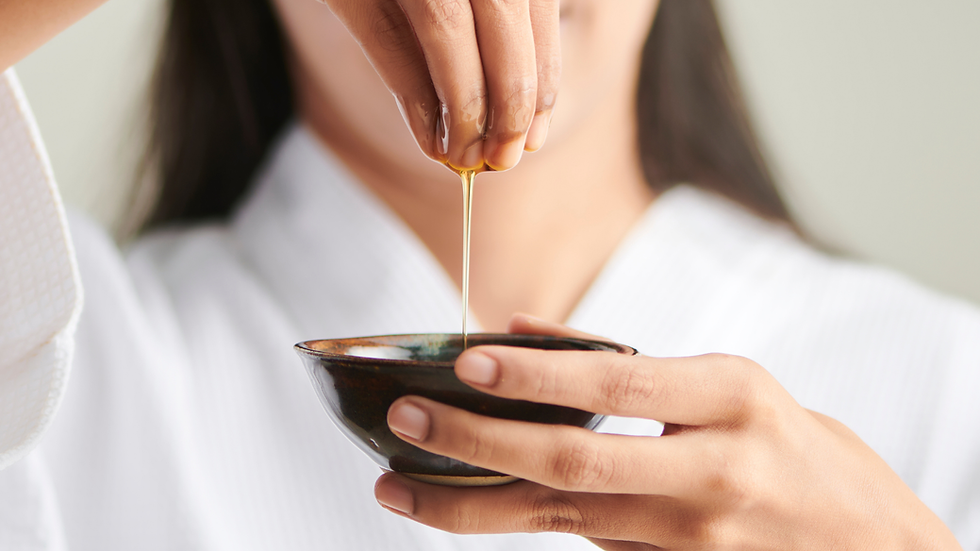
The oil you choose should suit your constitution, the season, and your needs of the moment. Sesame oil is the finest all-around choice, because it helps balance all three energies, Vata, Pitta, and Kapha. Herb-infused oils go a step further, carrying the qualities of specific herbs into the practice.
A simple way to choose:
For grounding restless Vata (Air energy): warming, nourishing oils like sesame or sunflower, with calming herbs such as Ashwagandha or Brahmi, are traditionally chosen to settle this scattered energy.
For cooling excess Pitta (Fire energy): cooling oils such as coconut or almond, often paired with soothing herbs like rose, jasmine, Shatavari, and sandalwood.
For lightening the heavy qualities of Kapha (Water energy): more stimulating oils such as mustard or safflower, with warming herbs like ginger or turmeric.
When selecting a herb-infused oil, look for one made with a quality base oil and real herbs rather than added fragrance, ideally organic, so what reaches your deepest tissues is genuinely nourishing.
When to Skip Abhyanga
Abhyanga is broadly supportive, but Ayurveda names a few times to hold off: during an active Kapha aggravation (such as a cold with congestion), during a fever, during indigestion, immediately after a cleansing therapy, and during pregnancy unless you are guided by a qualified Ayurvedic practitioner.
A Practice Worth Keeping

Abhyanga is one of those rare practices that nourishes every layer of who you are: skin, tissues, nervous system, and spirit. The Ayurvedic texts say its effects resemble being saturated with love, that same deep feeling of stability, warmth, and comfort. Practiced with full attention, the body answers. The skin softens and glows, the body feels stronger and more nourished, sleep deepens, and a grounded calm settles through the nervous system.
For a nervous system that runs too fast, too full, too often, there may be no simpler daily care than warm oil and your own two hands. This is the gift of Sneha, oil and love, offered by the person who matters most.
You are worth it. Today, and every day.
With steadiness, Julie Wardwell, Clinical Ayurvedic Practitioner

References
Charaka Samhita, R.K. Sharma and Bhagwan Dash, Chaukhamba Sanskrit Series Office, Varanasi, 2011; Sutrasthana Ch. 5.
Sushruta Samhita, Sharira Sthana Ch. 4, Chaukhambha Orientalia, Varanasi, 2005.
Vagbhata, Ashtanga Hridayam, Vol. I, Srikanta Murthy KR (ed.), Krishnadas Academy, Varanasi, 1994; Sutrasthana Ch. 2.
Morhenn V., Beavin L.E., Zak P.J. "Massage Increases Oxytocin and Reduces Adrenocorticotropin Hormone in Humans." Alternative Therapies in Health and Medicine, 2012; 18(6): 11–18.
de Jong T.R. et al. "Effects of Self-Touch and Social-Touch on Peripheral Oxytocin Concentrations." Physiology & Behavior, 2025.
Li Q. et al. "Foot Massage Evokes Oxytocin Release and Activation of the Orbitofrontal Cortex and Superior Temporal Sulcus." Psychoneuroendocrinology, 2019.

