_edited.png)
Imbolc and the Sacred Gift of Sheep's Milk: The Ancestral Nourishment Our Bodies Remember
- juliewardwell
- Feb 1
- 12 min read
Updated: Jul 11

February 1st marks Imbolc (IM-bulk), one of the four great Celtic fire festivals that celebrated the rhythms of nature and survival. The name reveals everything. It comes from the Old Irish i mbolg (ih-MOLL-ug), meaning "in the belly," a reference to pregnant ewes heavy with lambs, and from Óimelc (OH-melk), from ói-melg (OH-EE-melg), meaning "ewe's milk."
This is the season of sheep's milk. After the hardest winter months, when stored food ran dangerously low, the ewes began lambing in early February, and their fresh milk made all the difference. It was the line between thriving and barely making it.
Imbolc is the traditional time to seek out fresh sheep's milk and the foods made from it: creamy sheep's milk yogurt, rich sheep's milk cheese, cultured sheep's milk butter. Whether one lives in Ireland or belongs to the vast worldwide diaspora, this seasonal food still matters for health today. The sheep's milk that sustained Irish ancestors for six thousand years carries nutrients our bodies adapted to over countless generations, an adaptation that lives in our lineage still, wherever we now find ourselves.
Six Thousand Years of Adaptation
Around 4000 BC, the first domesticated cattle, sheep, and pigs arrived in Ireland. Archaeological evidence from Ferriter's Cove (Cuan an Chaoil), on the westernmost tip of the Dingle Peninsula in County Kerry, includes cattle bones and a sheep's tooth dated to 4350 BC. These animals introduced a dairy-centered way of eating that shaped Irish biology at its foundation.
When people eat the same foods, season after season, for thousands of years, their bodies adapt to process those foods efficiently. Enzymes develop. Gut bacteria specialize. Metabolic pathways settle into their most efficient forms. Over six thousand years, roughly three hundred generations, this adaptation became part of who the Irish people are. It lives in their descendants today, in every corner of the diaspora.
Why Sheep's Milk Came First: Nature's Perfect Timing

Sheep are seasonal breeders, governed by daylight. As the days shorten after the summer solstice, the fading light triggers hormonal changes in the ewes. By late September through November, they naturally come into season. Five months later, in February, the lambs are born and the milk begins to flow.
Cattle work differently. They can cycle every twenty-one days year-round, breeding in late spring and calving from March through May. Cattle brought wealth and summer abundance, but they were not the animals that carried people through late winter, when the food stores were lowest.
Sheep delivered fresh milk precisely when it was needed most. This timing was not managed. It was observed and honored. The tenth-century Irish text Tochmarc Emire (TOKH-mark EV-ir-uh), "The Wooing of Emer," records Imbolc as "the time in which the sheep came out and were milked."
This is why Imbolc celebrates ói-melg, ewe's milk. Not cattle's milk, though cows meant far more wealth and volume. Not goat's milk, though goats added valuable diversity. Ewe's milk was nature's perfect gift, arriving before any other fresh milk was available. That seasonal wisdom holds to this day. Sheep's milk is still available in late winter and early spring, when the ewes naturally give birth, so seeking it out at Imbolc connects us to a very old rhythm.
The Milk Economy: The White Foods That Sustained Life

Ancient Ireland operated without coins. Wealth was measured in cattle, and even legal fines were reckoned in milk cows and calves. These were dairy cattle, the small-bodied ancestors of today's Kerry cow, producing the rich golden milk that became Ireland's foundation.
Our ancestors called their dairy-centered way of eating bánbia (BAWN-vee-ah), literally "white foods," from bán (white) and bia (food). For centuries before the potato, Irish people lived primarily on milk, curds, soft cheese, and butter. This bánbia pattern defined Irish nourishment and sustained the people more than meat or fish ever did.
Sheep contributed the crucial seasonal milk of late winter and early spring, exactly when it mattered most. Their wool gave clothing and warmth. Goats added resilience, grazing marginal land and giving milk year-round. Together, these animals formed a diverse dairy system tuned to Ireland's seasons. But it was the sheep's milk, flowing at Imbolc at winter's darkest point, that marked the turn toward survival and abundance.
Transforming Abundance: Preservation Through Fermentation

Fresh milk spoils quickly. Our ancestors developed ways to extend its life, transforming it into forms that could be stored through the cold months when fresh milk was scarce.
Fresh milk was drunk while it lasted, including bainne clabair (BAHN-yuh KLAB-ir), "thick milk," a naturally soured milk enjoyed when available. But extending the milk's life was essential for survival. When cream was gathered over several days before churning, natural bacteria fermented it, and our ancestors found that cultured dairy kept far longer than fresh. The art of making cultured butter and fermented cheese carried the milk's goodness through winter and into spring.
Traditional Irish butter, called im (eem), was naturally cultured, because fermentation occurred before churning. The buttermilk left behind became a drink rich in beneficial bacteria. Pressed curds became gruth (gruh), eaten fresh or aged into cáis (kawsh), cheese. Butter was packed into cool, oxygen-free peat bogs, which kept it from spoiling while lending it strong, distinctive flavors from the bog itself.
Modern research now confirms what those methods accomplished: fermentation increases the availability of nutrients, produces beneficial bacteria that support digestion, breaks down lactose, and even creates vitamins including B12 and K2. What began as practical preservation became foundational nourishment. To taste sheep's milk cheese or cultured butter at Imbolc is to taste preservation wisdom refined over millennia, methods that align remarkably with what science now shows makes food highly digestible and nutrient-dense.
Brigid's Sacred Connection to Sheep and Milk

The goddess Brigid, one of the most powerful figures in Celtic mythology, held three aspects: poetry and inspiration, healing and herbcraft, and smithcraft and fire. But her power reached into what mattered most for survival: the fertility of the land, the livestock, and the people.
Brigid watched over pregnant ewes, guarded their safe lambing, and kept the milk flowing. Imbolc, celebrated on the 1st and 2nd of February, marked the moment the ewes came into milk and winter's darkness began to yield to spring. The festival's very name, Óimelc, ewe's milk, ties directly to her power over this life-giving food.
In Irish myth, Brigid also held sway over cattle, ensuring their fertility and abundance. She blessed the herds, protected them, and kept the milk flowing. Stories tell of her bestowing cattle on those in need and multiplying dairy through her divine power. Where her favor rested, it was said, udders filled with rich milk, butter churned easily, and cheese aged perfectly.
White cattle held particular significance in her mythology. White cows were sacred, connecting the earthly realm with the Otherworld, and white cattle with red ears were linked to the Sidhe, the fairy realm, as manifestations of divine presence. But it was the ewes, heavy with lambs, their udders swelling in February, that marked Brigid's festival. Fire and milk, seemingly opposite elements, were united in her: fire transformed milk into butter and cheese, and at Imbolc, when her sacred flames were lit, they blessed the hearth and the dairy work that would resume with the flowing milk.
Ancient Wisdom from Ayurveda: Understanding Milk's Nature
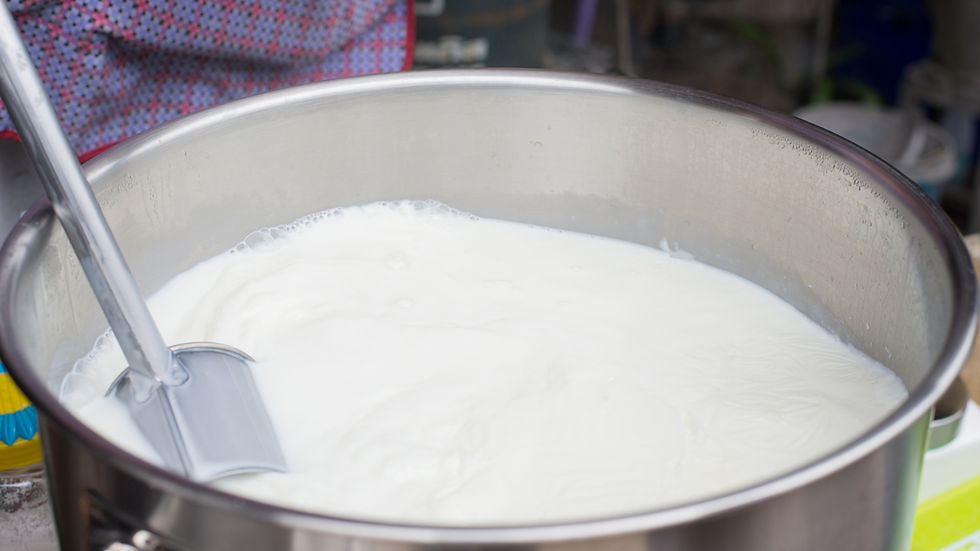
Ayurveda has worked with milk for over five thousand years, developing a deep understanding recorded in texts such as the Charaka Samhita and Sushruta Samhita. These texts describe milk as offering life-giving nourishment when the digestion is strong, and becoming a burden when the digestion is weak. The distinction is everything.
Ayurveda describes milk through its qualities:
Rasa (taste): Madhura (sweet), which nourishes the tissues and builds strength.
Virya (potency): Sheeta (cooling), excellent for soothing heat and inflammation, though it can feel heavy and dampen the digestive fire.
Vipaka (post-digestive effect): Madhura (sweet), offering deep nourishment and rejuvenation that builds tissue.
Guru (heavy) and Snigdha (oily): rich and moistening, which is why milk asks for strong digestion to break it down and use it well.
Abhishyandi (channel-blocking): it can turn sticky and create congestion when the digestive fire is weak.
Ayurveda names three energies that govern all of life: Vata (Air energy), which governs movement and the nervous system; Pitta (Fire energy), which governs metabolism and the digestive fire; and Kapha (Water energy), which governs structure, stability, and immunity. Properly prepared milk is understood to balance all three: grounding an anxious Vata, cooling an inflamed Pitta, and, with warming spices, turning Kapha's heaviness into nourishment rather than congestion. This is why the texts place such emphasis on preparation.
Ghrita (clarified butter, or ghee) holds a unique place in Ayurveda, prized for its ability to carry the properties of herbs deep into the body without losing its own benefits. Classical texts describe hundreds of herbal ghritas for specific purposes: Brahmi Ghrita for memory, Triphala Ghrita for digestion, Ashwagandha Ghrita for strength, and explain that ghee can reach all seven layers of tissue, the Dhatus (lymph, blood, muscle, fat, bone, nerve, and reproductive tissue).
The parallels between the Celtic and Ayurvedic traditions move me. Both cultures made cultured butter and cheese, kept sheep, cows, and goats for milk, and treated dairy as sacred. When I was in India, I watched the milkmen walking their cows by hand from door to door, treating them like queens as they delivered fresh milk. We have no evidence that the Celts infused their butter with herbs the way Ayurveda creates herbal ghrita, yet both peoples, worlds apart, developed ways to preserve and transform dairy into forms their bodies could truly use.
Choosing the Right Milk: A2 as Ancestral Nourishment

For most of the six thousand years that Celtic peoples raised cattle in Ireland, their herds gave A2 milk primarily. This matters when sheep's milk is out of reach, and it helps explain why modern dairy troubles so many people of Irish descent.
All milk contains beta-casein protein in two forms, A1 and A2. The difference is a single amino acid, but the effect on digestion is significant. Originally, all domesticated cattle produced only A2 milk. Then, sometime between five and ten thousand years ago, a natural mutation appeared in European herds and created A1 beta-casein, which spread slowly through trade and breeding. When Irish farmers began raising cattle around 4000 BC, their animals gave mostly A2 milk, and the Kerry cows that developed around 2000 BC remained predominantly A2.
Then came a dramatic and recent shift. Through the 1970s and 1980s, Irish dairy was transformed by the push for higher yields. High-producing Holstein-Friesians, an A1-dominant breed, were introduced on a massive scale, and within two decades Ireland's traditional cattle genetics were largely replaced. The Kerry cow became rare. The same pattern unfolded across much of the world, and especially in the United States. Today most milk in Ireland is a mixture of A1 and A2, and the pure A2 milk that nourished Irish people for nearly six thousand years became uncommon in just twenty years. In my own experience, I cannot comfortably drink the A1-dominant milk common in the US, while the organic milk I drink in Ireland sits far more easily.
Why does this matter? Research suggests that when the body digests A1 milk, it releases a compound called beta-casomorphin-7 that many people cannot fully break down, and that this may contribute to inflammation and digestive distress. Studies have found that A1 milk can produce symptoms much like lactose intolerance, even though the lactose content is identical. Ayurveda has a name for this kind of poorly digested food that turns into a burden in the body: Ama (AH-mah), the residue of incomplete digestion.
Sheep's milk and goat's milk are naturally A2, with far less A1 beta-casein than most modern cow's milk, and their smaller fat globules make them naturally easier to digest. This is another reason sheep's milk at Imbolc is so valuable: it offers the most digestible form of dairy at exactly the moment the body most needs a light but deeply nourishing food. When our ancestors milked the ewes at Imbolc, they were reaching easily digestible A2 milk just as winter stores ran low. Nature's timing gave precisely what was needed. Where sheep's milk is hard to find today, the same gift lives in A2 cow's milk from heritage breeds like Kerry, Jersey, or Guernsey, and in goat's milk, which is naturally A2.
Preparing Milk the Ayurvedic Way

Even easily digestible sheep's or A2 milk becomes gentler still with proper preparation, and Ayurveda offers practical methods refined over centuries.
The heart of it is simple: always boil the milk. Bring it to a full boil, then reduce the heat and let it simmer for three to five minutes. The texts explain that boiling begins to break the proteins into smaller, more digestible parts and shifts the milk from heavy and cold toward light and warm.
Warming spices, added while it simmers, make it easier still:
Cardamom, considered the best companion to milk, helps prevent congestion while calming the mind. Two or three crushed pods, or a quarter teaspoon ground, per cup.
Sweet cinnamon (Cinnamomum verum) supports steady energy. A small stick or a quarter teaspoon ground.
Ginger aids digestion and circulation. A thin slice of fresh, or an eighth teaspoon dried.
Nutmeg, in the evening only, encourages deep sleep. Just a pinch.
Turmeric with a pinch of black pepper makes Golden Milk, soothing and warming. A quarter teaspoon of turmeric to a cup, with pepper to help the body absorb it.
A few guidelines the texts hold firmly: never drink milk cold, as cold dulls the digestive fire and invites congestion. Sip it warm and slowly. Take it on its own, or only with sweet foods like dates, rice, or almonds. Avoid pairing it with sour, salty, bitter, or heavy foods, a combination Ayurveda calls Viruddha Ahara (vir-OO-dha ah-HAH-rah), "incompatible foods," which tends to form Ama. The evening, an hour or two before bed, is the best time of all, when warm spiced milk is said to nourish Ojas (OH-jas), the body's vital reserve, calm the mind, and ease the way into restful sleep.
Why This Matters for Health Today

In my practice, working with people of Irish and Celtic heritage around the world, I see the same pattern again and again: people eating foods their bodies were never shaped for. Modern processed foods. Industrial A1 dairy from grain-fed cows kept indoors. Vegetables and grains flown in from distant climates.
Consider this. A grandmother born in the 1940s or 1950s grew up drinking mostly A2 milk from traditional Irish cattle. The great shift to A1-dominant herds came in the 1970s and 1980s. So many of the digestive troubles people notice with modern dairy are responses to a change in the milk itself, one that happened within living memory. The body still carries the same inheritance the grandmother carried, but the milk on the shelf is molecularly different from what she drank as a child. When someone says, "I used to be able to drink milk, but now I can't," they may be responding to exactly this recent change.
Our bodies carry six thousand years of adaptation to the foods our Irish ancestors ate. Our digestion settled around dairy from grass-fed animals, giving A2 milk primarily. When we eat in a way that honors that inheritance, especially foods grown naturally and in season, something eases. Inflammation often settles. Digestion improves. Energy steadies. This is simply the body recognizing what it was long shaped to use.
This does not mean every person of Irish descent can or should have dairy. Individual variation is real. Some genuinely cannot process any dairy at all, and sensitivities develop for many reasons, from gut damage to chronic stress. But for those who tolerate it, choosing dairy that matches this long adaptation can make a real difference. In the Imbolc season, that means fresh sheep's milk where it can be found, or sheep's milk yogurt, cheese, and cultured butter, and where sheep's milk is not available, A2 cow's milk from grass-fed heritage breeds, or goat's milk, ideally in cultured forms rich in beneficial bacteria.
Returning to What Sustained Us

Each early spring, I mark Imbolc by returning to the food that defined it. I seek out fresh sheep's milk when I can find it, at a local farm or a specialty market. I look for sheep's milk yogurt, rich and creamy, and sheep's milk cheese, from fresh and soft to aged and sharp, and cultured sheep's milk butter when it can be had. When sheep's milk is beyond reach, I honor the season with goat's milk or A2 cow's milk from heritage breeds, cultured into yogurt or kefir, made into butter, aged into cheese, or prepared the old Ayurvedic way, boiled gently, spiced with cardamom, and sipped warm in the evening.
This is what Imbolc holds: nature's perfect timing, providing exactly what was needed. Fresh milk arriving as the stores ran low. Nourishment flowing when survival hung in the balance. The continuation of life through food our bodies still remember. That is not only mythology. It is biology, culture, and six thousand years of adaptation working together, and it is wisdom the Irish, worldwide, can still draw on to build genuine health from the foundation up.
This is not wellness as a trend. It is wellness as remembrance.
Julie Wardwell, Clinical Ayurvedic Practitioner

References
Whitehouse, N.J., et al. (2014). Neolithic agriculture on the European western frontier: the boom and bust of early farming in Ireland. Journal of Archaeological Science, 51, 181–205.
Woodman, P.C., Anderson, E. and Finlay, N. (1999). Excavations at Ferriter's Cove, 1983–95: Last Foragers, First Farmers in the Dingle Peninsula. Bray: Wordwell.
Rosa, H.J.D. and Bryant, M.J. (2003). Seasonality of reproduction in sheep. Small Ruminant Research, 48(3), 155–171.
Kelly, F. (1997). Early Irish Farming: A Study Based Mainly on the Law-Texts of the 7th and 8th Centuries AD. Dublin Institute for Advanced Studies.
Lucas, A.T. (1989). Cattle in Ancient Ireland. Boethius Press.
O'Sullivan, A. and McCormick, F. (2014). Cattle in Ancient and Modern Ireland: Farming Practices, Environment and Economy. Cambridge Scholars Publishing.
Ryder, M.L. (1983). Sheep and Man. Duckworth.
Stokes, W. (1891). The Wooing of Emer. Revue Celtique, 12, 109–111.
Joyce, P.W. (1903). A Social History of Ancient Ireland (Vol. 1). Longmans, Green, and Co.
Earwood, C. (1997). Bog butter: a two thousand year history. Journal of Irish Archaeology, 8, 25–42.
MacKillop, J. (1998). Dictionary of Celtic Mythology. Oxford University Press.
Connolly, S. and Picard, J.M. (1987). Cogitosus's Life of St Brigit. Journal of the Royal Society of Antiquaries of Ireland, 117, 5–27.
Dash, B. and Sharma, R.K. (2001). Caraka Samhita (Vol. 1–3). Chowkhamba Sanskrit Series Office.
Frawley, D. (2000). Ayurvedic Healing: A Comprehensive Guide (2nd ed.). Lotus Press.
Lad, V. (2002). Textbook of Ayurveda: Fundamental Principles (Vol. 1). The Ayurvedic Press.
Note: Individual responses to dairy vary. Those with lactose sensitivity often tolerate cultured forms better than fresh milk. It is always wise to find what genuinely suits your own constitution.


