_edited.png)
Midsummer on the Wild Atlantic: Foraging Four Solstice Flowers on Cape Cod

At the summer solstice, the sun's light shines at its brightest, and its heat is the most intense. The sun climbs to its highest point in the northern hemisphere and seems to pause for a few long days, and the light shines golden over the dunes. Here on Cape Cod, the beach roses are bursting open and filled with buzzing bees, marking summer's true arrival.
In that same light, the earth brings forth its bounty. This is at the heart of what I want to share, the oldest wisdom I know: our ancestral foods, gathered and eaten fresh in season. This is the surest path I have found to bring balance, strength, and vitality to my health and wellness. Not a diet, but a syncing with earth's rhythm and wisdom.
To see how and why it works, we will follow the sun.
The Year's Long Fire

In Ayurveda, summer is the season of Pitta (Fire energy). During this time, the sun's fire is often compared to the intensity of a campfire. A fire starts slow, builds to a roaring blaze, then burns through its fuel and sinks to embers, to ash, and finally a cold ring of stones.
The sun follows the same continuous cycle throughout the year. From the depths of the winter solstice, the year's fire kindles and climbs through spring, reaching its peak at the summer solstice. It then simmers down through autumn until it returns to cold ash at the winter solstice, where the cycle begins anew.
The Ayurvedic texts describe two halves of the year: Adana Kala, the heating season of taking, when the sun and wind absorb moisture from the earth, runs from the day after the winter solstice to the summer solstice. And Visarga Kala, the cooling season of giving, when rain and cool winds return that moisture, begins the day after the summer solstice and ends on the winter solstice.
Two solstices, two poles of one fire.

The two solstices are opposite poles of this fire, and the earth is brought into balance by the opposite energies it produces: cold versus hot, dry versus moist, and light versus heavy. And so the land provides what our bodies need.
At the summer solstice, the light stands at its strongest height. The earth runs hot, and so do we; Pitta rises in our bodies the same way it rises in the sky. And here is the surprise: the brightest fire is also the most depleting. Ayurveda teaches that our digestive strength, the Bala (strength) of our Agni (digestive fire), sinks to its lowest now, at the peak of the summer heat, and will not regain full force until the winter solstice. So the land responds to summer's heat with cooling, watery, astringent, and bitter green plants that are fully ripe and easy to digest. This helps us balance the heat.
At the winter solstice the sun's fire has gone to ash. Yet now the body's own inner digestive fire burns strong, and strength and hunger reach their yearly peak. So the land responds to winter with the opposite, warming, rooted, nourishing plants that can be stored and are heavy to digest. Each pole of the solstice calls for what will balance it, and our digestive fire is synced to this rhythm if we listen.
As above, so within.
Ayurveda goes one step deeper, and this is the part I love most. The three powers that move the universe move inside the body too. The sun lives in us as Pitta. The moon, cooling and nourishing, lives in us as Kapha (Water energy). The wind that drives them both lives in us as Vata (Air energy). Loka Purusha Samya (the world and the individual are one), the Ayurvedic texts teach: the earth and all living beings arise from a single shared rhythm. The great fire of the year is not just burning out on the dunes. It is burning within me, as I am in sync with the sun and moon.
The Oldest Bargain: Why the Season's Food Is the Right Food

If the earth's rhythm and its people are in sync, so are the plants. We share an old bargain with the plants. They breathe out the air we breathe in. And the five great elements that structure the plants (earth, water, fire, air, and the space that holds them) produce the six tastes: sweet, sour, salty, pungent, bitter, and astringent.
Ayurveda calls these six tastes the Shadrasa (six tastes of Ayurveda), and teaches that they work directly on our bodies, building us up, cooling us down, drying us out.
We are assembled and balanced by what the plants produce.
And they do not offer their tastes at random. Each season brings forward the taste that season needs. Through the cold, damp, heavy months, Kapha gathers in the body just like ice and snow, and melts as the earth starts to warm in spring. Right in sync, the plants answer with bitterness; the sharp wild shoots and bitter leaves of early spring are light and cleansing. They cut winter's heaviness and ready the body for the summer heat to come. Bitter is the lightest, most cleansing taste there is, so spring's greens balance us after the heavy winter.
It happens this way all year, the season stirring a force in us, its plants offering the taste that settles it. Like increases like, which produces excess (illness), and is brought back into balance by its opposite energy. We did not invent this arrangement; this is adaptive evolution, and our ancestors adapted to this seasonal rhythm. This is why eating our ancestral foods in season has never felt like a diet to me. What ripens around me now is what my body requires for balance. If we lean too hard on what was flown in from the far side of the world, out of its time and place, then our bodies fall out of sync with nature. A small disharmony, but a real one.
I follow this more by instinct than by ledger. I don't weigh my plate against a chart or refuse a winter orange. But I stay with the season, eating what the land and my local growers give when they give it, and letting the wild larder set the menu more often than not.
Tending the Fire at Midsummer
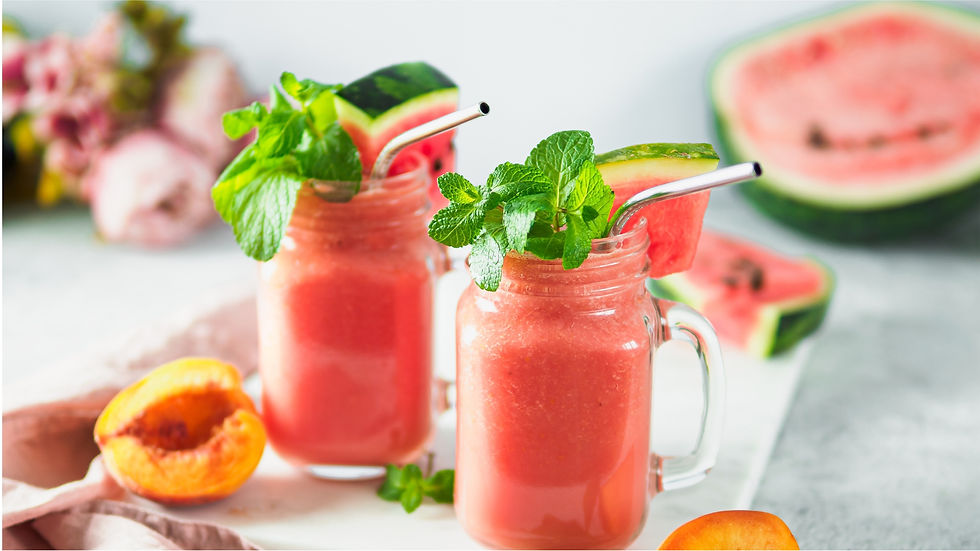
Through the hot months the principle stays simple: to balance the heat, invite its opposite. A few ways I keep my own fire tempered without letting it burn too high:
Eating cool. I favor the sweet, bitter, and astringent tastes that calm Pitta, and ease off the spicy, sour, and salty ones that stoke it. Cucumber, melon, coconut, leafy greens, mint, sweet ripe fruit, and cooling teas of mint, rose, elderflower, and hawthorn.
Eating light. Since digestion is at its weakest, I stay away from heavy-to-digest meats, which are also heating. I save them for the cooler season. Dairy is my protein choice during summer; it is cooling, and especially soft cheeses, like mozzarella, ricotta, and farmers cheese, are light to digest and combine well with veggies and light grains.
Moving in the cool hours. I save effort for morning and evening and let midday be for shade, water, and rest. A swim in the cool ocean or lake is one of the great Pitta soothers, and on Cape Cod I'm never far from the ocean.
Guarding sleep. Pitta energy keeps the mind racing into the night, so I dim the lights, give myself a real cooling wind-down, then sit outside under the moonlight.
Breathing cool. On a hot, intense day I inhale a slow breath through my curled tongue and exhale through the nose, a cooling breath the Ayurvedic texts call Sheetali. A few rounds and the inner stress of heat eases.
To our ancestors, the summer solstice was a gathering, fires on the hilltops, feasting in the long daylight. I feel deeply connected to my ancestors every time I attend a traditional Cape Cod clam bake on the beach. It's essentially a bonfire dug in the sand, layered with seaweed, clams, lobster, corn on the cob, and potatoes. It's quite a feast. I offer pitchers of cool herbal tea, foraged and blended from my home first-aid kit, to my whole circle of family and friends. Tending my people with wildflowers is its own kind of solstice fire.
Our Celtic ancestors knew this bright blazing day. In Ireland it belonged to Áine, goddess of the land and summer sun, her name meaning brightness itself; on Midsummer's Eve the people lit fires on her sacred hill and carried torches through the fields to bless the land. And there is Lugh, the Shining One, god of light and skill. When I stand on the beach at the height of the light, I feel them close, the same fire our ancestors celebrated with hilltop bonfires.
A Barefoot Morning: Foraging at the Height of the Fire
A few mornings ago, I went beach walking. I set out early, just as the sun lifted off the open sea, the air cool and salty, the wet sand refreshing under my bare feet. I had come to see what the ocean had washed up overnight and was quickly redirected to the wildflowers that had other plans.

Wild Rose came first, at the edge of the sandy soil where the beach meets the woodland, deeply pink and with an unmistakable sweet scent. Under its delicate perfume, rose is genuinely bitter tasting, and bitter is the most cooling taste of all, which is why it calms and settles an overheated mood. Every summer, I create an infusion blended with rose, nettle, motherwort, elderflower, and hawthorn for a cooling, nourishing, heart-healthy tea.

Deeper in the woodland where it opens up to a field, I found the Elder, a rare find here. I came upon just three bushes and took only a few umbels from each, the forager's first rule and one I never break. Aromatic and lightly bitter, cooling to Pitta, elderflower goes into my summer teas, and when there is an abundance, I make a sweet syrup that makes plain sparkling water taste like the solstice itself.

At the sunny field's edge, Yarrow stood everywhere, lacy and white, green-bitter when I crushed a frond. This is the one I gather in abundance. Bitter and so cooling, it has helped ease fevers for as long as anyone has recorded herbal knowledge. It was famous on the battlefields for slowing bleeding and knitting skin together. I dry it to make a tea and tincture for colds and flu, and blend it into the skin-healing balm that is a must for everyone's first-aid kit.
And scattered through the same sunlit field, the gold of St. John's Wort, blossoms turned up like little suns. Of course it was blooming; it always blooms midsummer. This is Áine's flower, gathered by our ancestors for the solstice fires. When I pinch a bud, my fingers stain deep red, the sign of the ruby oil it gives in the sun. This oil is the heart of the body oil I make for aches and the sharp pain that travels along the nerves.
What I cannot use fresh, I keep the old ways, steeped in oil, simmered to syrup, drawn into tincture, dried whole and out of the light, never powdered. And always I take less than I could, leaving plenty for the bees, the berries, and whoever walks this way next.
Flowers as Nourishment and Healing

Nature's healing gifts always seem to arrive right when they are needed. It is a remarkable synchronicity that rose and elderflower calm the heart, yarrow soothes a fever, and St. John's Wort cools nerve pain, all growing together in the same sunny field at the ocean's edge.
This is the wisdom our people lived by before it had a name: to eat what the land gives, in the season it gives it, and the body settles into balance almost on its own. So on this longest day, while the fire of the year stands at its peak, I walk the shoreline barefoot, gather what is ripe and willing, and carry it home, as our ancestors did on this same blazing day.
This is not wellness as a trend. It is wellness as an ancestral legacy.
Julie Wardwell, Clinical Ayurvedic Practitioner

Sources
In the spirit of honesty, this work asks that of me: wild rose has a documented place in Ayurveda, but elder, yarrow, and St. John's Wort are North Atlantic plants the texts never named. Their energetics here are read the way Ayurveda reads any plant, through its tastes and qualities, not drawn from citation.
The seasonal teaching rests on the Ritucharya (seasonal regimen): Charaka Samhita (Sutrasthana Ch. 6 and Ch. 12, Sharirasthana Ch. 5), Sushruta Samhita (Sutrasthana Ch. 6), and Ashtanga Hridaya (Sutrasthana Ch. 3), for the solar journeys of Adana and Visarga, the yearly cycles of strength and taste, Loka Purusha Samya, and Pitta as Anala (fire). Rose appears in the Bhavaprakasha, Dhanvantari, and Raja Nighantus. Notes on the four flowers draw on traditional Western and Unani herbal sources and on published research into their compounds (elder's flavonoids, yarrow's chamazulene and apigenin, St. John's Wort's hypericin and hyperforin, rose's polyphenols). The Celtic threads come from Irish folklore of Áine and Lugh, and of St. John's Wort gathered at Midsummer.
