_edited.png)
Spring Healing Plants of Ireland and the North Atlantic: The First Greens of the Season

Spring is the season when the earth renews itself through new growth. As the days lengthen after Imbolc and reach Cónocht an Earraigh (the Spring Equinox), the ground begins to wake, and the first green shoots push up through soil that has been barren for months of cold. I look for them early, before they are ready, curious to see what is stirring. For our Celtic ancestors, who had no supermarkets and relied entirely on what the land and sea provided, these first tender greens after a long, barren winter were a moment of profound relief, the first fresh nourishment after months of stored food.
My focus is on the ancestral foods of the whole North Atlantic, but this guide rests on the spring plants of Ireland, and for a good reason. Ireland offers the fullest picture of the native healing plants found along the eastern edge of the North Atlantic: the nettles, dandelions, sorrel, watercress, and wild garlic our Celtic people gathered for thousands of years. When they crossed to the Canadian Maritimes and New England, they carried the plants they knew as food and healing, and those plants took root and naturalized. Today the same greens grow on both shores, so Ireland serves as a point of reference whether one stands in Brittany, Nova Scotia, or on my own stretch of Cape Cod.
What I keep returning to is the long relationship beneath it all. Our ancestors gathered nettle, sorrel, watercress, dandelion, and wild garlic as the earth thawed, year upon year, for countless generations. These plants were already growing here long before people walked the land. Over vast stretches of time, the bodies of our Celtic people adapted to what the earth was already producing, and that adaptation lives in our lineage today. These early greens became the nourishment our bodies came to rely on as winter broke. Helping people find their way back to them is the heart of my work.
Shadrasa: The Six Tastes and Why Spring Greens Taste Bitter

Ayurveda, the earth-based healing science of India, follows the laws of nature, and those laws hold everywhere on earth. That is why it reads the seasons of the Wild Atlantic as clearly as the seasons of India.
In Ayurveda, spring is Kapha Ritu (the Kapha season), governed by Kapha (Water energy), which is made of the water and earth elements. Through the cold, damp winter, Kapha gathers in the body by nature's design, building reserves of warmth, insulation, and nourishment to carry us through the dark months. Then, as the light returns and the air warms, that stored Kapha begins to melt and move, exactly like snow softening on the hills.
When too much Kapha lingers, it shows as heaviness, low appetite, congestion and excess mucus, water retention, mental fog, and a general sluggishness. That heaviness dampens Agni (digestive fire), and a weak Agni lets Ama (metabolic toxins) settle into the tissues. This is why Ayurveda treats spring as the most important season for cleansing.
At the center of Ayurvedic food wisdom sits the Shadrasa (six tastes of Ayurveda): sweet, sour, salty, pungent, bitter, and astringent. Each taste is more than a flavor. Each is built from two of the five elements (earth, water, fire, air, and ether), and that composition decides how a taste behaves in the body. Each taste also has its season.
Three of them are the building tastes, and they carry the heavier elements:
Sweet (earth and water): moist, cool, heavy. Nourishes all tissues, builds strength, increases Ojas (vital reserve). Dominant in early winter.
Sour (earth and fire): moist, hot, heavy. Stimulates appetite and digestion. Dominant in early autumn.
Salty (water and fire): moist, hot, heavy. Aids digestion, softens tissues, clears the channels. Dominant in autumn.
The other three are the cleansing tastes, and every one of them carries the air element, which makes them dry and light, the very opposite of Kapha's moist heaviness:
Pungent (air and fire): dry, hot, light. Kindles Agni, dries excess moisture, clears congestion, breaks up stagnation. Dominant in summer.
Bitter (air and ether): dry, cool, light. The most powerful Kapha reducer. Purifies the blood, cools inflammation, firms the skin and muscles. Dominant in early spring.
Astringent (air and earth): dry, cool, light. Tones and tightens tissue, absorbs excess fluid, supports healing. Dominant in spring.
Here is the pattern I find so beautiful. The building tastes are moist and heavy, the same qualities as Kapha, so sweet, sour, and salty foods increase it: like increases like. The cleansing tastes are dry and light, Kapha's opposite, so they reduce it: opposites balance. And when the first plants break through the spring soil, they arrive predominantly bitter, astringent, and pungent, the exact tastes that draw winter's heaviness out of the body. No one designed this for our benefit. These plants were here long before us. But over countless generations, our bodies adapted to what the land already offered in its season, and the Shadrasa gives us the language to understand why the early greens settle us so well after a heavy winter.
Ayurveda teaches that all six tastes belong in a balanced life, yet the emphasis shifts through the year. Winter leans on the building tastes for warmth and nourishment. Spring leans on the cleansing tastes to clear what winter left behind. So much ill health traces back to eating out of season, from foods flown in from the far side of the world, out of their time and place. The land, left to its own rhythm, offers exactly what the body needs, exactly when it needs it.
The First Spring Greens I Watch For
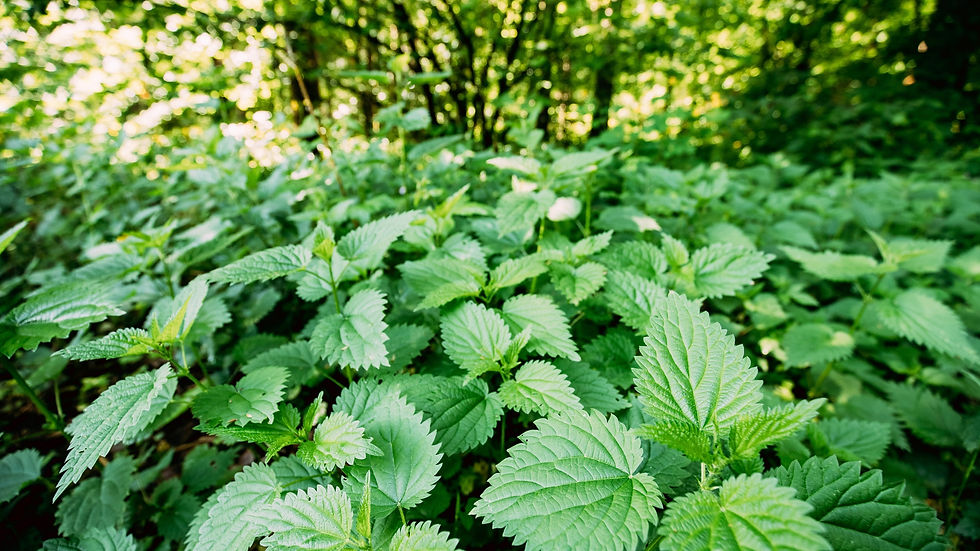
At the equinox, the harvest is not yet in full swing. This is the threshold, the weeks when I walk the damp edges and woodland floors watching the earliest greens appear, marking where I will return to gather once they come fully into their strength.
Nettle, neantóg (NYAN-tohg), is the one I look for first. One of the great spring tonics, rich in iron and minerals, long used to cleanse the blood after winter. There is an old Irish saying that three nettles in May keep all illness away. In Ayurvedic terms, nettle is bitter and astringent, cooling, made for scraping Kapha. The sting vanishes entirely the moment the young tops meet heat.
Dandelion, caisearbhán (KASH-ar-vawn), also called Bearnán Bríde (Brigid's herb), rises in every field and verge. A supreme liver cleanser and one of the most important bitter tonics of spring. The young leaves are eaten as a green, the roots roasted into a bitter coffee. In Ayurvedic terms, it is predominantly bitter, reducing Kapha and waking a sluggish Agni.
Wild garlic, creamh (KRAV), floods the woodland floor with its pungent, sweet scent before the trees fully leaf out. Leaves, buds, and blossoms are all gathered. Valued so highly under the old Brehon Laws that taking it from another's land carried a fine. Its pungent, warming nature makes it an excellent Kapha-reducing food.
Watercress, biolar (BIL-ur), grows along the clean running streams, peppery and mineral-rich, prized in Ireland since antiquity. Legend even credited it with carrying Saint Brendan to a great old age. That sharp, peppery bite is the plant's way of stirring the digestive fire after winter.
Chickweed, fliodh (FLYUH), spreads low and abundant across gardens and turned ground, mild and fresh as young lettuce, cooling and gentle, a soothing green that also calms irritated skin.
Cleavers, garbhlus (GAR-uv-lus), climbs up through the hedgerows, sticky and green. One of the great spring lymphatic cleansers, best taken as a cool overnight infusion. In Ayurvedic terms, it moves stagnant lymph, a key action for clearing Kapha.
These are the ones I reach for first, but they are only the doorway. Behind them comes a much longer procession as the season deepens: sorrel, hawthorn's young leaves, garlic mustard, plantain, yarrow, dock, burdock, and the deeper healing herbs the Bean Feasa (wise women) and Bean na Luibheanna (herb women) once gathered. And out along the shore, the spring seaweeds begin their fresh new growth, dulse, carrageen (Irish moss), laver, and kelp among them, some of the most mineral-dense foods on earth, harvested young and dried to carry the sea's nourishment through the whole year. Each of these deserves its own telling, and in its own season I will give it.
The Beginning of Spring Foraging

This is what the equinox means to me. Not the harvest itself, but the promise of it. The ground softening, the first bitter shoots testing the air, the whole cleansing larder of spring beginning to stir along both shores of the Wild Atlantic.
The knowledge of these plants was carried for generations by the herb women and wise women of Ireland, gathered fresh each spring and passed hand to hand. There is an old saying, Tá luibh ar gach leigheas, there is a herb for every ailment. Over thousands of years, the earth's seasonal rhythm wove itself into the bodies of our people, and the bitter, astringent, and pungent greens that rise each spring are the very foods our lineage adapted to rely on after winter's weight. The Shadrasa simply gives that old instinct a language.
So I watch, and I wait, and soon enough I gather.
This is not wellness as a trend. It is wellness as remembrance.
Julie Wardwell, Clinical Ayurvedic Practitioner
