_edited.png)
The Wild Atlantic's First Offering: The Season of Bealtaine
The light shines differently in May.

I notice it first out on the water. Here on the wilds of the west Atlantic shore, the sea catches the evening light in a way it simply doesn't in March or April. The days stretch longer and shimmer with a luminescent glow at sundown, and I linger outside, not quite ready to go in. I was born on a salty, windblown sixty-five-mile-long peninsula that juts out into the Wild Atlantic Ocean, with over 560 miles of coastline, sand dunes, and beaches. The outer shore of Cape Cod is my home, surrounded by a vast community of Celtic diaspora carrying centuries of quiet seasonal traditions.
For more than forty years, I have followed the seasonal changes along the arc-shaped coastline of the Wild North Atlantic. I journeyed from Cape Cod along the coast of Maine and further north to Cape Breton, and east across the water to the wild western shores of Ireland, Wales, and Scotland. What I found along the way changed how I understood everything about food, about the land, and about what our Celtic ancestors carried with them when they crossed the Atlantic. They did not come empty-handed. They brought their native plants, their healing knowledge, and their seasonal wisdom, and those plants took root on the western shores and became naturalized, as if the land itself recognized them. The eastern side of the Atlantic warms earlier than the western, so the timing is never exact, but with the onset of the Bealtaine season, the same trees and plants begin to bloom on both sides of the Wild North Atlantic in May. The wild garlic, nettle, and hawthorn are the first plants I forage. Each one arriving in its own time, in its own way, on shores separated by three thousand miles of open ocean.
The Celts called this season Bealtaine. The great turning. The first day of summer by their understanding. Bealtaine is the festival of the long days of northern light returning. Lighting bonefires was the community's way of celebrating the light and the nourishment it would bring to all life. Our ancestors marked it by burning what winter had left behind, relighting every household flame from one shared communal source. A whole community connected to the same flame on the same night, a kind of purification, cleansing the old and making room for the new. I think about this as I build my own purification fire on the beach of the Outer Cape in May. The gesture is older than any of us can fully know.
But what I want to talk about is what the land is offering.
Bealtaine is the season's first offering, the hopeful beginning of what might become abundance, if the weather is kind and the Wild Atlantic storms hold off long enough to let the trees fruit and the plants seed, allowing the growing season to find its way. Walking the Wild Atlantic beaches during the weeks of May, I feel gratitude for what is here now, and a watchful hope for the months ahead.
What Our Bodies Are Asking For During Bealtaine

Most of us arrive at this season carrying more than we realize.
A heaviness that settled in around November and never quite shifted. Slower digestion that the cold, damp months encouraged. Congestion that accumulated quietly in the chest and now is melting like the snow. And weight that gathered through winter and has not yet moved. This is the season of Kapha (Water energy), which builds through the cold months and asks to be released as the earth warms. By the time May arrives, the body is ready to let go of the excess, and the plant offerings of spring give us exactly what we need to shift from heaviness to lightness.
The bitter greens pushing up through every field. The pungent wild garlic flooding the forest floor. The astringency of the hawthorn flower. The native plants of the Wild Atlantic offer just what we need: strong bitter, astringent, and pungent tastes, three of the Shadrasa (six tastes of Ayurveda), that help our bodies cleanse away the heaviness of winter and settle Kapha. This is the wisdom of seasonal native plants. They offer us what we need when we need it. Native seasonal foods are at the heart of my practice: the foods that have grown on the North Atlantic shores for thousands of years. Over countless generations, the bodies of our Celtic people adapted to these foods, and that adaptation lives in our lineage today, which is why returning to them in their season is not a wellness trend. It is a biological homecoming.
The Green Offering of Bealtaine

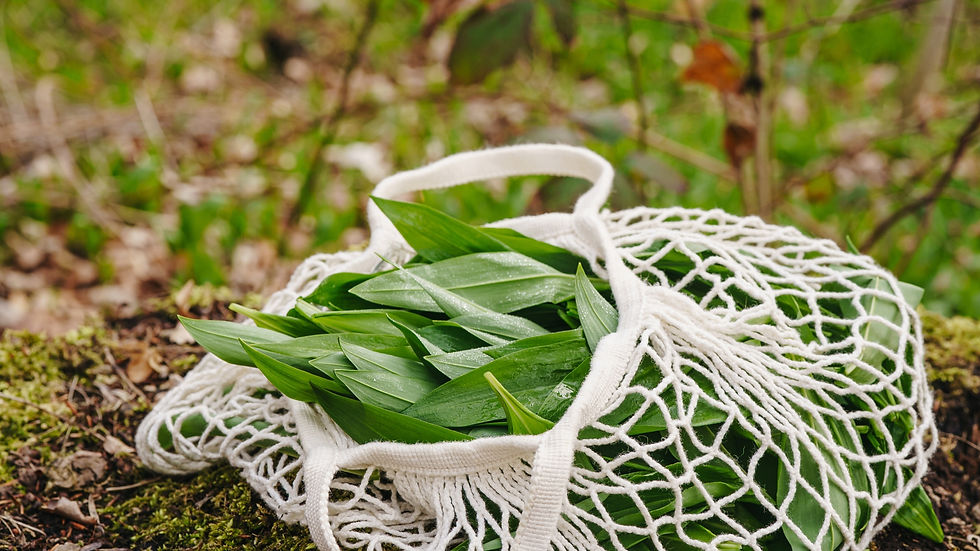
The ramps are the first thing I look for.
In the wet woodlands near the shore, usually in the second week of May, I find them growing in loose colonies, their broad leaves pushing up before the trees have fully leafed out. The smell hits first, pungent yet sweet. Ramps are the wild leek of North America, Allium tricoccum, the closest relative we have on this side of the Atlantic to the wild garlic known as creamh in Irish, which carpets the woodlands of the Wild Atlantic every May. Every part is gathered and used: the broad leaves before the flowers open, the flower buds as they appear, the open blossoms. The Welsh Physicians of Myddfai, the herbalists who documented plant healing from within the Celtic tradition, recorded wild garlic for stomach complaints and swelling. Hildegard von Bingen of Germany noted its uses for lung support and wound care. I harvest the leaves and make pesto, stir-fry vegetables, or mix them into fresh butter. Nothing is wasted. I harvest carefully, gathering intermittently throughout the colony, and always leaving the bulbs in the ground.

The nettles arrive with the wild garlic and grow in every field and hedgerow, and here on the west Atlantic shore they appear in the same damp, sheltered edges, along fence lines, near water, in the corners where the soil runs deep and dark. There is an old Irish saying that three nettles in May keep all illness away. The young tips, gathered before the plant flowers, offer extraordinary mineral-dense nourishment, more than anything on a shelf. I make pots of nettle soup throughout May. The young nettle tips, a good broth, a knob of butter stirred in at the end. Nettle soup is one of the most genuinely nourishing yet cleansing things I know to make. The recipe is as old as the season itself.

Then the hawthorn, known as Sceach Gheal in Irish, the white thorn. The old Celtic way of marking Bealtaine was not by the calendar but by watching for the hawthorn to bloom. When the hedges go white, it is Bealtaine. I look for it along the same roadsides every May, the same trees, the same white flowering moment. The young leaves emerge just before the flowers open, sweet and nutty, gathered and eaten fresh from the hedge. Then the astringent flower buds open, and the blossoms are steeped into tea infusions and cordials. Both Hildegard von Bingen and the Welsh Physicians of Myddfai referenced hawthorn as strengthening both the physical and the emotional heart.
Along the streams grows watercress, its peppery, mineral-rich flavor a delicacy. In every field, dandelions grow, their young leaves and flowers edible. The roots are dried into a bitter tea that supports the liver through the seasonal change. Along roadsides and field edges, Fat Hen, known as praiseach fhiáin in Irish, grows like wild spinach, and most people walk past without recognizing it. The young leaves are more nourishing than anything cultivated, and its seeds were found in Iron Age storage pits across the Celtic lands. Across the Wild North Atlantic, these highly nourishing yet cleansing foods are offered to us by the land.
What the Cows Offer During Bealtaine

If the wild greens are the land's opening offer, the dairy is its celebration.
Bealtaine was, at its core, a milk festival.
The cattle, sheltered through winter on stored fodder, were driven to the high summer pastures for the first time, to the buaile in Irish, the mountain booley, to graze on the first lush spring grass. The spring calving brings milk richer and more abundant than at any other time of year. Women who followed the herds spent the season churning butter, pressing curds, and filling vessels with what the Irish called the bánbhia, the white foods that would carry their communities through the spring and summer months.
Fresh sweet milk, drunk warm from the cow. Butter churned from cream ripened for three days, golden and sweet, so precious that Celtic folklore carried warnings about its need for protection. Surplus butter was packed into wooden vessels and buried deep in the cold peat of the bog, a preservation tradition stretching back 3,500 years that modern chemistry confirms worked. Buttermilk, left to sour and thicken naturally at room temperature, was drunk at every meal. Soft white curds called gruth in Irish were so central to the summer diet that they appear in Ireland's Brehon Laws as both a recommended seasonal food and an acceptable form of payment.
Saint Gobnait, or Gobnait Naofa, the 6th-century Celtic healer of Ballyvourney in County Cork, is regarded as one of the three great Celtic healers, and her life's work was built on two of Bealtaine's most essential offerings: the honey of her bees and the milk of her community's cattle. In Celtic Ireland, honey was the only sweetener known, an important food and a documented healing agent. Where the cows moved to summer pasture and the bees returned to the first May flowers, nourishment and healing arrived together on the same land, from the same season's generosity. They were never separate.
This is where I go first at the farmers' market in May. The local creamery. The grass-fed butter. The cultured buttermilk. The fresh cow's-milk cheese. This is Food as Medicine, offered by the season.
From the Shore

The sea opens in May too.
The mackerel arrive first to the outer shores from their winter depths in the Atlantic. The first significant fish of the summer season, caught fresh and eaten the same day, or smoked and salted for keeping. Cod and haddock are the great native deepwater fish of the North Atlantic, part of the broader Celtic diet throughout the year, gathered by boats fishing further offshore. But the mackerel are the shore's own spring announcement, and every Wild Atlantic coastal community knew to watch for them.
Periwinkles from the rocks at low tide. Cockles from the tidal flats. Mussels from the coastal beds. The shell middens found across the Wild Atlantic coastline are the deep record of how important shellfish were. The sea gave freely, and nothing it offered was wasted.

Historical records confirm that the Celtic agricultural year included a spring pig slaughter in April, placing fresh pork directly on the Bealtaine offering. The cattle were too valuable in milk. The wild pig was the woodland forager, the deeply mythological animal of Celtic tradition, and the meat of the season, smoked, salted, or cooked fresh over the fire.
Under all of it, the last of the stored provisions. Old oats and barley from the autumn harvest, ground each morning and cooked simply on a griddle. Dried peas and beans from last season's stores, simmered into thick broths. The new grain was months away. What remained of the old was used carefully until the new harvest.
The Offering Is There
No one needs to be standing on a Wild Atlantic shore to meet this season.
The ramps are in the wet woodland. The nettles grow along the fencerows. The hawthorn is blooming in the fields. The farmers' markets are opening with the first spring plants and dairy. The mackerel are running close to shore. The Wild Atlantic's first offering is here, on both shores, in the season of Bealtaine, as it has been for as long as our lineage remembers.
These are the native foods of the Celtic lands, the seasonal ancestral foods our people adapted to over thousands of years. On the shores of the Wild Atlantic, food and healing have never been two different things. The Bealtaine season is when that relationship opens again, quietly and without ceremony, in every wet woodland and along every Wild Atlantic shore.

This is what I come back to every May, standing on the shore, watching the light go long over the water.
The earth's first offering is there. All I have to do is forage or source it, gently and with gratitude, taking less than the land gives.
This is not wellness as a trend. It is wellness as remembrance.
Julie Wardwell, Clinical Ayurvedic Practitioner
